
Milan Fashion Week was never this popular in India amongst the masses until The Kolhapuris made a kick-ass entry.
And guess what? No Indian designer brought them to such a big platform. It took Prada to get inspired by our GI-tagged craft and put it in the spotlight, more spotlight than even the Indian astronaut going to space after 41 years from our country!
I’m proud to witness that our handmade crafts have the power to command an international stage. But it’s also frustrating to see them shine without the recognition they truly deserve.


Why Weren’t They on Our Runways First?
Why have the biggest Indian fashion designers never showcased Kolhapuris on their runways?
Just some time back, we were all going gaga over the Met Gala and Cannes looks. So why weren’t our Indian stars seen wearing these with their attire?
The world applauded Diljit Dosanjh’s look because he brought Sikh history to the global stage.
And yet, when it comes to Kolhapuris, one of our most iconic crafts, we needed a foreign brand to make us care?
We React to the Internet, Not Our Roots
Try Googling Kolhapuri Chappals now, you’ll find that the entire first page is about this scandal.
Somewhere in Maharashtra, a cobbler probably sneezed… and his legacy got monetized.
Not the First Fashion Heist ( Remember, Dior )
This isn’t the first time global fashion’s flirtation with India crossed into appropriation.
Remember Dior’s Resort 2018 collection? The one with the block-printed dress worn by Sonam Kapoor?
That exact yoga pose print was designed by Orijit Sen, founder of People Tree, India : an ethical Indian label that had been printing it since 2000.
Dior didn’t credit him. The internet roared. Sen demanded answers.
The result? An out-of-court settlement and a very expensive reminder that Indian crafts aren’t your Pinterest mood board.

These brands rarely acknowledge the artisans behind the design. Kolhapuri makers sell their pieces for ₹300 to ₹1,500, often without access to high-end markets or recognition. Meanwhile, luxury houses rake in lakhs without sharing credit or profits.
In a just world, every pair of high fashion Kolhapuris would come with:
– A tag naming the artisan who made it
– A brief history lesson (free with every step!)
– A share of profits going back to the community
But in our world, they come with runway lighting, fancy names, and maybe a bored model looking into the distance.

Before we target, reshare, and comment on yet another international brand stealing from the world of our handicrafts—let’s learn about the origin of this beautiful craft.
The Royal Sole: Origins of the Kolhapuri
The origin of Kolhapuri Chappals dates back to the 12th century, when King Bijjala and his Prime Minister Basavanna encouraged their production to support local cordwainers.
By the 13th century, these were being worn widely. Known earlier as Kapashi, Paytaan, Kachkadi, Bakkalnali, and Pukri, the names reflected the villages they originated from. Shahu I of Kolhapur and his successor Rajaram II promoted the craft, setting up 29 training centres during their reign. History records the Saudagar family as having created the design we recognize today in 1920. The earliest model – thin, with two side flaps was known as “Chappal with ears” or “Kanwali.”

It first hit the Bombay market via J.J. & Sons, who quickly reordered more due to the high demand. From there, the Kanwalis and soon, the Kolhapuris took off.
By the 18th century, they were being crafted in adjoining towns of Maharashtra as well.
In July 2019, Kolhapuri chappals received their Geographical Indication (GI) tag from the Controller General of Patents, Designs & Trademarks.
This tag now belongs exclusively to eight districts Kolhapur, Sangli, Satara, Solapur (Maharashtra) and Bagalkot, Belagavi, Dharwad, Bijapur (Karnataka).
Crafting a Kolhapuri: A Six-Week Journey
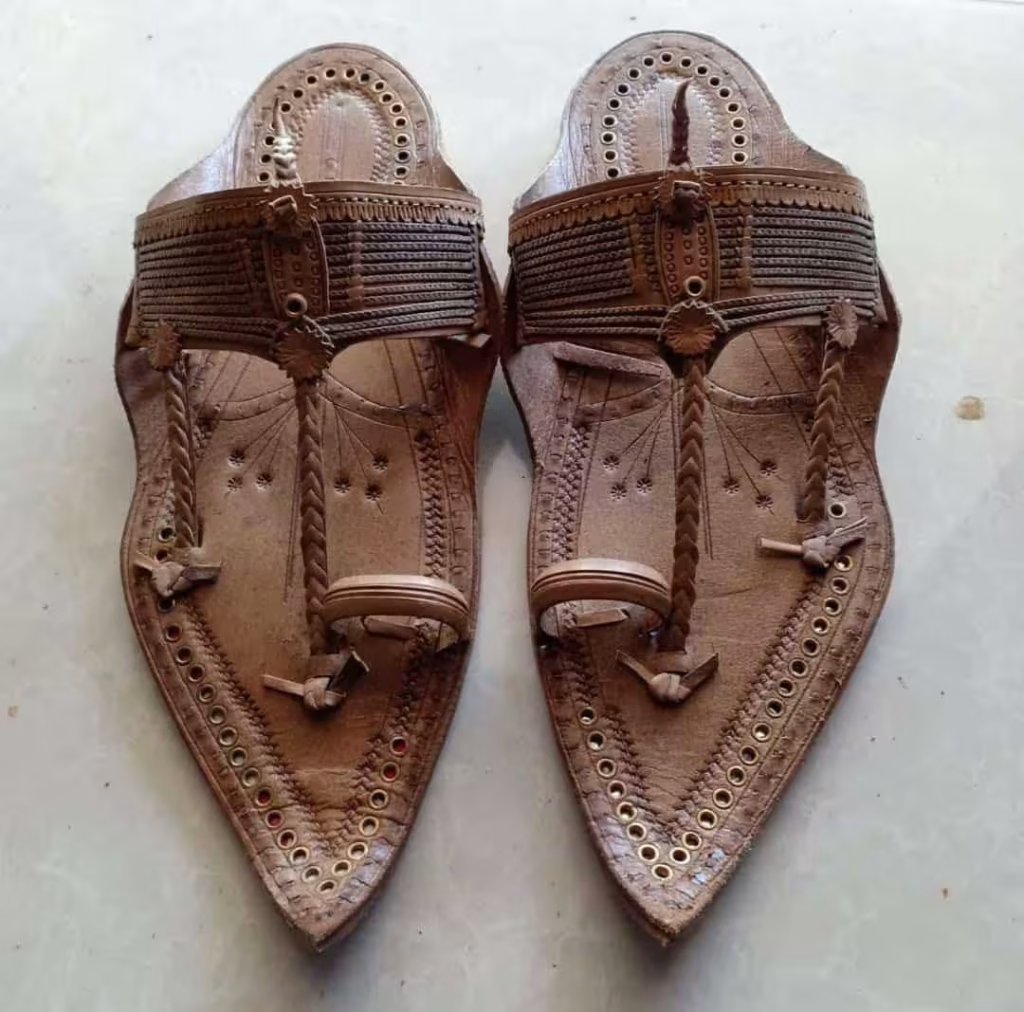
It can take up to six weeks to make a pair of Kolhapuris.
- Originally made from buffalo-hide and thread, they weighed as much as 2.01 kg because of the thick sole, designed for Maharashtra’s harsh terrain.
- Steps include: skiving, pattern making and cutting, upper and heel attachment, stitching, finishing, punching, trimming, decoration, polishing, and assembling.
- They were dyed with vegetable dyes and initially styled as open-toed, T-strap sandals.
- No nails or sharp materials are used. Stitching and punching are done entirely by hand.
- Hides of cow, goat, and buffalo are processed through grazing to harden the leather for durability.
- Once processed, the base is cut based on pre-designed templates. Then dyed in three traditional shades: natural, oil, and polish.
- The sole is stitched using only leather cords designed to mold to your foot over time.


The Economic Struggle of the Makers
Despite the design’s popularity and versatility, Kolhapuri artisans face massive financial constraints.
– They struggle against market domination by high-end brands.
– Even though their designs stay in trend, low sales threaten their livelihoods.
Let’s not forget: Kolhapuris are not just footwear. They are a gift from history showcasing culture, identity, and the patience of handcraftsmanship. There are even lesser-known types like Kapashi and Dongari, all handmade using 100% genuine leather free of any allergy-causing agents.
Please check the below project for a detailed knowledge on the Kohlapuris:
DASTAKARI – CRAFT DOCUMENTATION ON KOHLAPURI CHAPPALS
Walk Forward, But Don’t Forget the Roots
Let’s not cancel Prada (okay… maybe give them a strong side-eye). Let’s use this moment to spotlight Indian craftspersons.
I’ve worn Kolhapuris for a long time and still own a beautiful collection including a customized chappal made by an artisan in Auroville, Pondicherry in 2018. It’s still in perfect shape and comfort.
What Can You Do?
- Buy directly from local makers.
- Visit your nearest craft bazaar and meet the people behind the product.
- Tell your friends the real story behind Kolhapuris.
- Give credit where it’s due even if fashion doesn’t.
Because the next time someone asks why your sandals don’t have a logo, you can smile and say, “They have history instead.”
Credits: Vhaan, Wikipedia, Click on the photos for the original source.